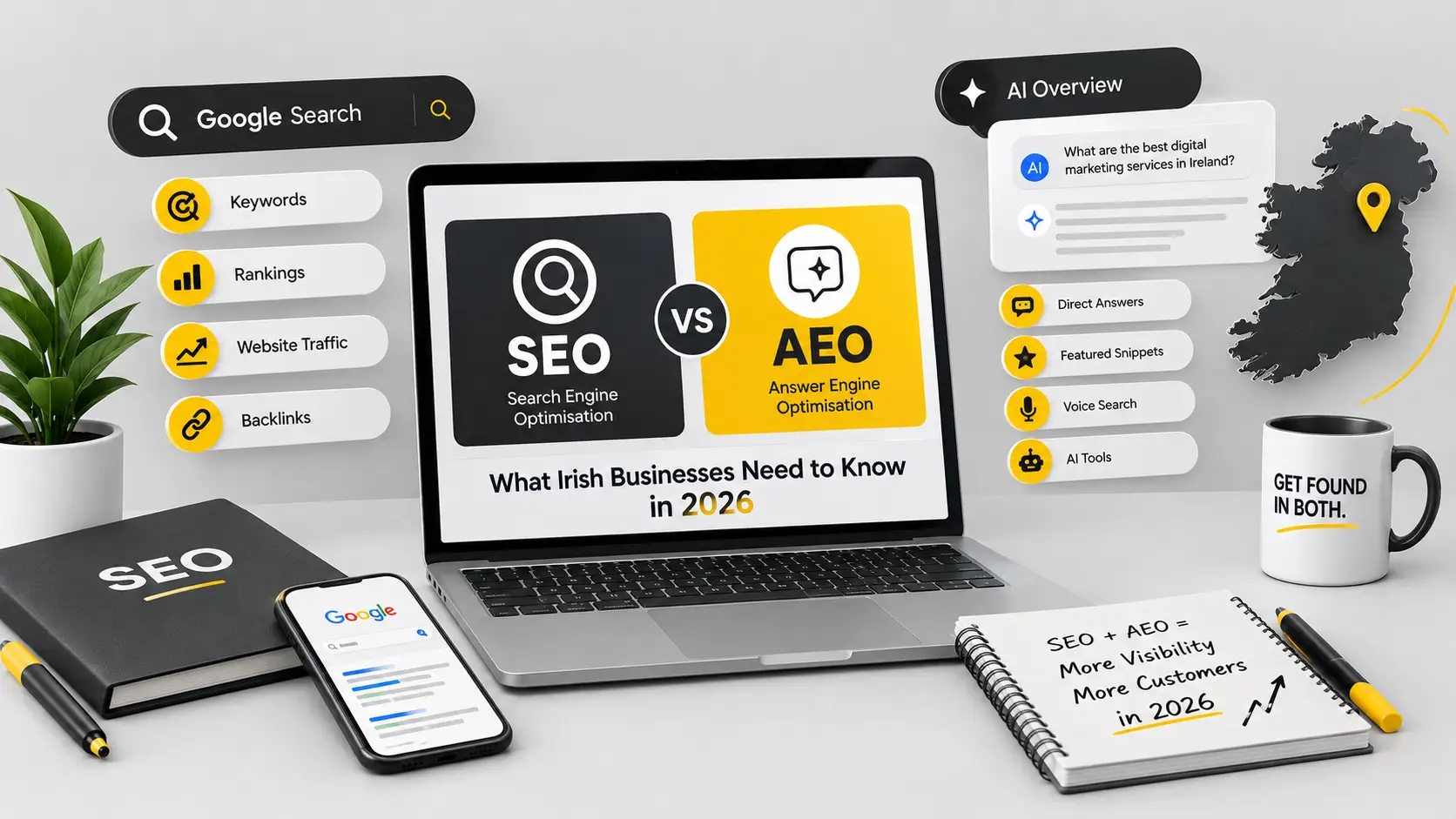

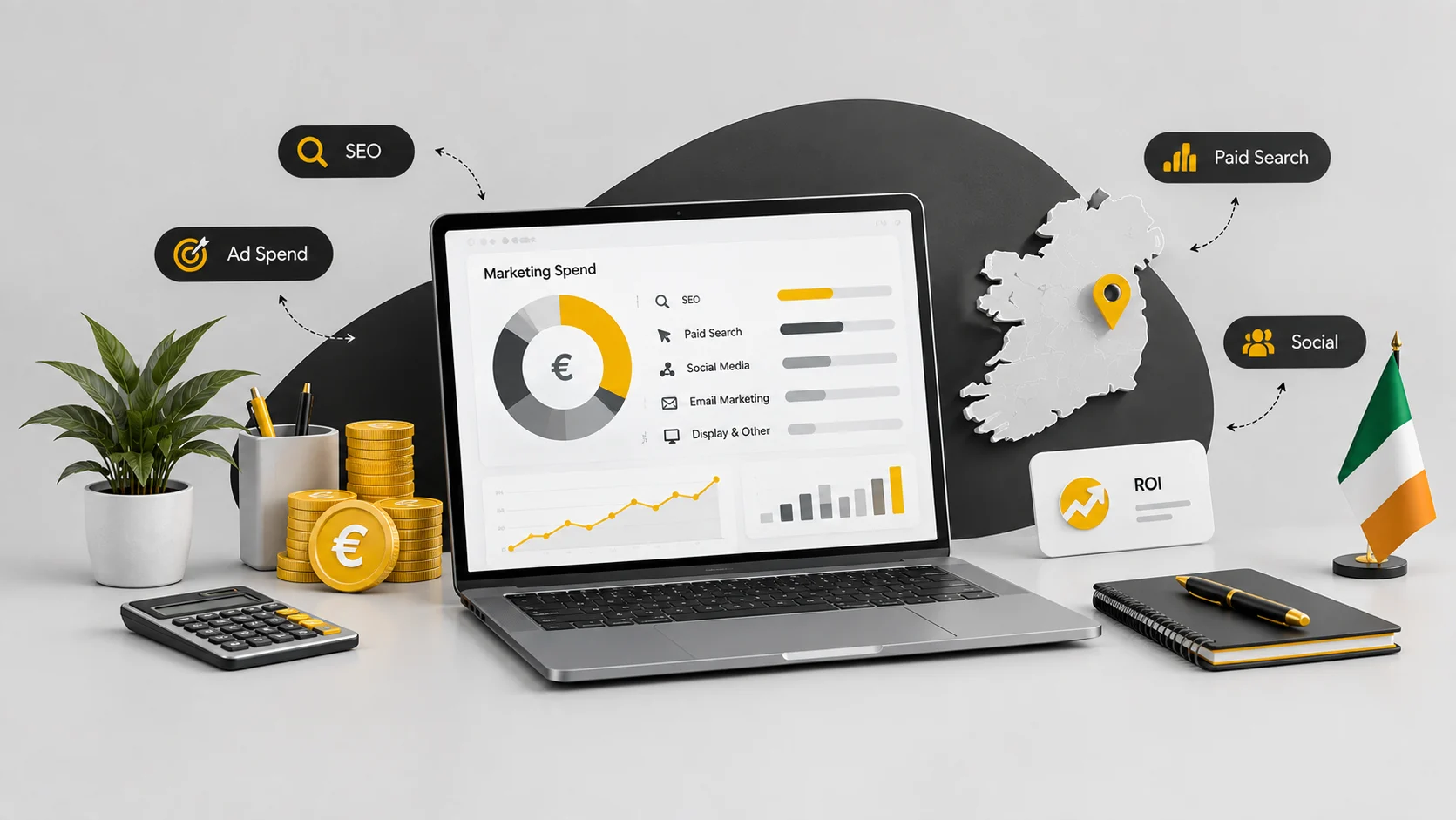
Most Irish businesses should spend between 5% and 10% of their annual revenue on digital marketing, with established businesses at the lower end and newer or fast-growing businesses closer to the top of that range. In practical terms, that means a small Irish business with 500,000 euros in revenue would typically budget somewhere between 25,000 and 50,000 euros a year, or roughly 2,000 to 4,000 euros a month.
That is the short answer. The honest answer is that the right number for your business depends on your industry, your competition, your growth goals, and where you are starting from. This guide breaks it all down clearly so you can work out a realistic figure for your own situation. As a digital marketing agency in Dublin working with Irish businesses since 2020, these are the numbers and frameworks we actually use.
The Simple Rule: A Percentage of Your Revenue
The cleanest way to set a digital marketing budget is as a percentage of your revenue rather than a figure plucked out of the air. This keeps your spending proportionate to the size of your business and scales naturally as you grow.
The widely accepted benchmark is 5% to 10% of annual revenue spent on marketing, with a significant portion of that going to digital channels. Established Irish businesses in stable markets with strong word of mouth can often sustain growth at the lower end, around 5%. Newer businesses, or those in competitive sectors trying to build visibility from scratch, usually need to be closer to 10%, and sometimes higher in the first couple of years.
For context, the most credible international benchmarks land in a similar place. Gartner’s 2026 CMO Spend Survey put average marketing budgets at around 7.8% of company revenue. Digital now absorbs the majority of that spend, which makes sense given where Irish consumers actually spend their time and attention.
What Does That Actually Look Like for an Irish Business?
Percentages are useful, but most business owners want to see real numbers. The figures below are typical market averages for Irish businesses and vary depending on your specific industry, competition, and goals. They are a guide, not a fixed price list.
These are starting points rather than fixed rules. A niche business with a small, clearly defined audience might get excellent results from a smaller, focused budget. A business in a highly competitive Irish sector like legal services, insurance, or property may need to spend considerably more just to compete for visibility.
Why Your Industry Changes the Number
Two Irish businesses with identical revenue can have very different marketing budgets, and both can be right. The difference usually comes down to how competitive their sector is and how much a single customer is worth to them.
A solicitor or an accountant in Dublin operates in a competitive, high-value market. A single new client might be worth thousands of euros over time, which justifies spending more to win them. The cost of Google Ads keywords in these sectors is also higher because everyone is bidding for the same searches. These businesses often need to spend at the higher end of the range to see results.
A local trade or a niche service business might operate in a less competitive space where a smaller, well-targeted budget goes a long way. For these businesses, getting the Google Business Profile right and running a modest, focused Google Ads campaign can deliver a strong return without a large monthly spend. The point is that there is no single correct figure. There is only the figure that makes sense for your specific business.
Where Should an Irish Business Spend Its Digital Marketing Budget?
Knowing how much to spend is only half the question. Knowing where to spend it is what actually determines your return. Here is a sensible way to think about allocating a digital marketing budget for an Irish business, roughly in order of priority.
Google Business Profile and Local SEO
For most Irish businesses serving a local area, this is where the first portion of any budget should go. It delivers the highest return on investment of almost any digital marketing activity, and the Google Business Profile itself is free to set up. A realistic starting allocation is around 30% of your budget on local SEO and Google Business Profile optimisation. This is what puts you in front of people actively searching for your service nearby.
SEO and Content
Search engine optimisation and content are the long-term engine of your digital marketing. Unlike ads, the traffic SEO brings does not stop when you stop paying. A reasonable allocation is around 30% of your budget on SEO and content marketing. This is an investment that compounds over time, so it rarely delivers overnight results, but it builds a genuine asset for your business.
Paid Advertising (Google Ads and Meta)
Paid advertising is how you generate leads quickly while your SEO builds. For Irish service businesses, the cost per click on Google is typically between 1 and 5 euros, which is excellent value compared to traditional advertising. A common allocation is around 20% to 30% of your budget on paid ads, split between Google and Meta depending on your business. Our Google Ads management in Dublin helps Irish businesses get the most out of every euro of ad spend.
Email Marketing and Automation
Email marketing is one of the most cost-effective channels available and is often underused by Irish businesses. A smaller allocation of around 10% can deliver a strong return by turning existing customers and website visitors into repeat business. It costs relatively little to run and the returns compound as your list grows.
What Does Digital Marketing Actually Cost in Ireland?
If you are hiring an agency rather than doing it yourself, it helps to know what individual services typically cost in the Irish market so you can judge whether a quote is realistic.
- SEO services: Meaningful SEO work in a competitive Irish market typically starts between 800 and 2,500 euros per month depending on scope and competition.
- Google Ads management: Usually starts around 500 to 1,000 euros per month for management, separate from your actual ad spend.
- Social media management: Ranges from around 500 to 2,000 euros per month depending on how much original content and video is involved.
- Web design: A professional business website in Ireland typically costs between 3,000 and 15,000 euros as a one-off project, depending on complexity.
- Email marketing: Often bundled with other services, or priced from a few hundred euros per month depending on volume and automation.
These figures are general market averages for Ireland and vary significantly from business to business. For an accurate quote based on your specific needs, it is always best to get in touch with our team directly.
A word of caution. Any agency offering full-service digital marketing for a few hundred euros a month is not delivering real work at that price. They are either outsourcing everything overseas, relying entirely on automation, or taking on so many clients that none of them get meaningful attention. Cheap digital marketing in Ireland almost always costs more in the long run than investing properly from the start.
What Is the Minimum Budget to Start With Digital Marketing in Ireland?
If you are just starting out or working with a very tight budget, you do not need thousands of euros a month to make progress. A realistic minimum starting point for an Irish business is around 200 to 500 euros a month.
At that level, the priority is getting the fundamentals right rather than spreading yourself thin. Get your Google Business Profile fully optimised and active. Make sure your website is technically sound and works properly on mobile. Then run a small, tightly focused Google Ads campaign on your highest-value service. That combination, done well, will deliver a better return than a larger budget spread carelessly across too many channels.
The Most Expensive Mistake Irish Businesses Make With Their Budget
The biggest waste of a digital marketing budget in Ireland is not spending too little or too much. It is what we would call marketing scatter. Money and effort spread thinly across channels that are not aligned, not measured, and not delivering anything close to their potential.
Conservative estimates suggest Irish SMEs collectively waste tens of millions of euros a year on fragmented, uncoordinated digital marketing. Boosting the odd Facebook post here, running a random Google Ads campaign there, with no strategy tying it together and no clear way of measuring what is working. The result is a budget that disappears with very little to show for it.
What matters more than hitting a specific percentage is having a clear budget set in advance, allocated sensibly by channel, with a defined way to measure the return on each one. A smaller budget spent with focus and measurement will always beat a larger budget spent without either.
How to Know If Your Digital Marketing Budget Is Working
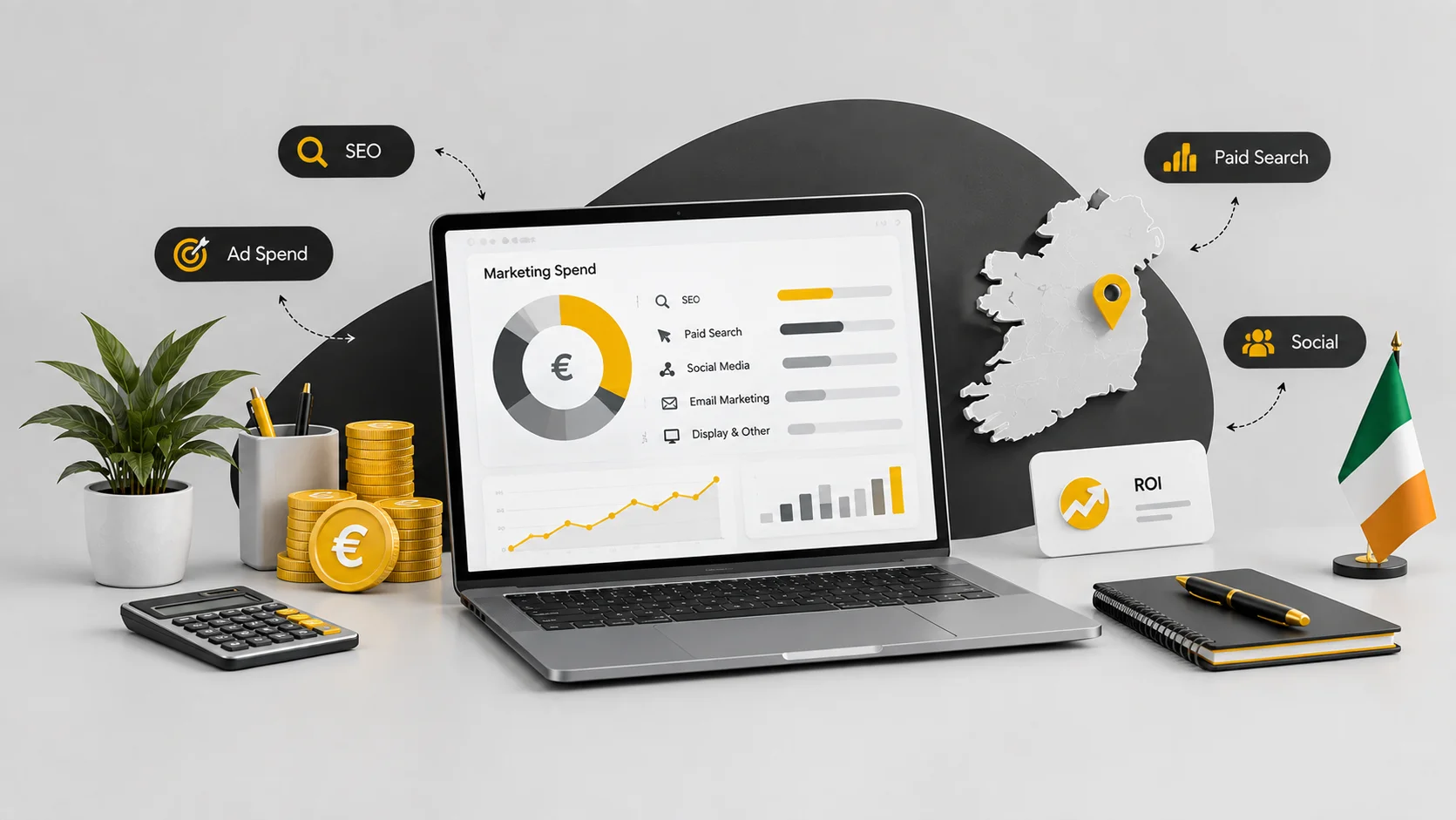
Setting a budget is pointless if you are not measuring what it delivers. The metrics that actually matter for an Irish business are the ones tied to money, not vanity. Cost per lead, which is how much you are spending to generate each enquiry. Cost per acquisition, which is how much it costs to win an actual customer. Return on ad spend, which is how much revenue comes back for every euro you put into advertising. And your overall conversion rate, which is the percentage of visitors who take the action you want.
If you are tracking these numbers properly, you can see exactly which parts of your budget are earning their keep and which are not. That lets you move money toward what works and cut what does not. If you are not tracking them, you are guessing. Our reporting and analytics service gives Irish businesses a clear, honest picture of exactly what their marketing budget is delivering.
How Waspermedia Helps Irish Businesses Get the Most From Their Budget
Since 2020, we have been helping Irish businesses spend their digital marketing budgets wisely across SEO, Google Ads, social media, web design, email marketing, and reporting. Whatever your budget, our job is to make sure every euro is working as hard as it can toward results that actually matter to your business.
We do not believe in spreading a budget thinly to look busy. We start by understanding your goals and your numbers, then we build a focused plan that puts your money where it will deliver the strongest return. And we report clearly every month so you always know exactly what your budget is doing.
If you want help working out the right digital marketing budget for your business and where to spend it, get in touch with our team and we will give you an honest, straightforward answer.
Conclusion
As a rule of thumb, most Irish businesses should budget between 5% and 10% of revenue for digital marketing, with the exact figure depending on your industry, competition, and growth goals. But the percentage matters far less than how you spend it. A focused, well-measured budget will always outperform a bigger one spent without a plan.
Start with the fundamentals, your Google Business Profile, local SEO, and a solid website. Add paid advertising to generate leads quickly. Build SEO and content for long-term growth. Track the numbers that tie to actual revenue. Do that consistently and your digital marketing budget becomes an investment rather than an expense.
FAQs
How much should an Irish business spend on digital marketing?
Most Irish businesses should spend between 5% and 10% of their annual revenue on digital marketing. Established businesses in stable markets can sit at the lower end, while newer or fast-growing businesses in competitive sectors usually need to be closer to 10%, or higher in their early years.
What is the minimum budget to start digital marketing in Ireland?
A realistic minimum starting point is around 200 to 500 euros a month. At that level, focus on getting your Google Business Profile fully optimised, making sure your website works well on mobile, and running a small, targeted Google Ads campaign on your highest-value service.
How much does an SEO agency cost in Ireland?
Meaningful SEO work in a competitive Irish market typically starts between 800 and 2,500 euros per month depending on scope and competition. Agencies offering comprehensive SEO for a few hundred euros a month are unlikely to be delivering real, effective work at that price.
How should an Irish business split its digital marketing budget?
A sensible starting split is around 30% on local SEO and Google Business Profile, 30% on SEO and content, 20% to 30% on paid advertising, and around 10% on email marketing. The right split depends on your business, but local SEO and your Google Business Profile should usually come first.
Is it worth spending money on digital marketing in Ireland?
Yes, provided it is spent with a clear plan and measured properly. Irish businesses with a structured digital marketing strategy generate a significantly higher share of their sales online than those without one. The businesses that waste money are the ones spending without strategy or measurement, not the ones investing wisely.
How do I know if my digital marketing budget is working?
Track the metrics tied to money rather than vanity numbers. Cost per lead, cost per acquisition, return on ad spend, and conversion rate tell you exactly which parts of your budget are earning their keep. If you are not tracking these, you have no reliable way of knowing what your spending is actually delivering.